Do You Need to Know Techniques of Integration
Basic Integration Principles
Integration is the process of finding the region bounded by a function; this process makes use of several important backdrop.
Learning Objectives
Apply the basic principles of integration to integral issues
Key Takeaways
Key Points
- The term integral may also refer to the notion of the anti- derivative, a function [latex]F[/latex] whose derivative is the given office [latex]f[/latex]. In this case, it is called an indefinite integral and is written, [latex]\int f(ten)\,dx = F(10) + C[/latex].
- Integration is linear, additive, and preserves inequality of functions.
- The definite integral of [latex]f[/latex] over the interval [latex]a[/latex] to [latex]b[/latex] is given by [latex]\int_a^b f = F\vert_a^b[/latex], where [latex]F[/latex] is an anti-derivative of [latex]f[/latex].
Cardinal Terms
- integration: the performance of finding the region in the x-y airplane bound by the function
Integration is an important concept in mathematics and—together with its inverse, differentiation—is 1 of the two principal operations in calculus. Given a function [latex]f[/latex] of a real variable [latex]x[/latex], and an interval [latex][a, b][/latex] of the existent line, the definite integral [latex]\int_a^b \! f(ten)\,dx[/latex] is divers informally to exist the area of the region in the [latex]xy[/latex]-airplane bounded past the graph of [latex]f[/latex], the [latex]x[/latex]-axis, and the vertical lines [latex]x=a[/latex] and [latex]x=b[/latex], such that area above the [latex]10[/latex]-axis adds to the total, and that below the [latex]10[/latex]-centrality subtracts from the total. The term integral may also refer to the notion of the anti-derivative, a role [latex]F[/latex] whose derivative is the given office [latex]f[/latex].
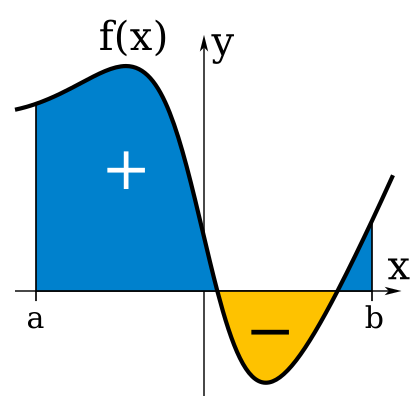
Definite Integral: A definite integral of a function can be represented every bit the signed area of the region divisional by its graph.
More rigorously, one time an anti-derivative [latex]F[/latex] of [latex]f[/latex] is known for a continuous real-valued role [latex]f[/latex] defined on a closed interval [latex][a, b][/latex], the definite integral of [latex]f[/latex] over that interval is given by
[latex]\displaystyle{\int_a^b \! f(ten)\,dx = F(b) - F(a)}[/latex]
If [latex]F[/latex] is one anti-derivative of [latex]f[/latex], then all other anti-derivatives will have the grade [latex]F(x) + C[/latex] for some constant [latex]C[/latex]. The collection of all anti-derivatives is called the indefinite integral of [latex]f[/latex] and is written as
[latex]\displaystyle{\int f\; \mathrm d x = F(x) + C}[/latex]
Integration gain by adding upward an infinite number of infinitely small areas. This sum can be computed by using the anti-derivative.
Backdrop
Linearity
The integral of a linear combination is the linear combination of the integrals.
[latex]\displaystyle{\int_a^b (\blastoff f + \beta g)(x) \, dx = \alpha \int_a^b f(x) \,dx + \beta \int_a^b 1000(x) \, dx}[/latex]
Inequalities
If [latex]f(ten) \leq g(10)[/latex] for each [latex]x[/latex] in [latex][a, b][/latex], and so each of the upper and lower sums of [latex]f[/latex] is bounded in a higher place past the upper and lower sums, respectively, of [latex]g[/latex]:
[latex]\displaystyle{\int_a^b f(x) \, dx \leq \int_a^b g(x) \, dx}[/latex]
Additivity
If [latex]c[/latex] is any element of [latex][a, b][/latex], and so:
[latex]\displaystyle{\int_a^b f(x) \, dx = \int_a^c f(x) \, dx + \int_c^b f(x) \, dx}[/latex]
Reversing Limits of Integration
If [latex]a > b[/latex],
[latex]\displaystyle{\int_a^b f(10) \, dx = - \int_b^a f(ten) \, dx}[/latex]
Integration past Substitution
Past reversing the concatenation dominion, we obtain the technique called integration past exchange. Given 2 functions [latex]f(x)[/latex] and [latex]one thousand(x)[/latex], we can apply the post-obit identity:
[latex]\displaystyle{\int [f'(g(ten)) \cdot g'(x)]\; \mathrm d ten = f(grand(x)) + C}[/latex]
or written in terms of the "dummy variable" [latex]u = g(x)[/latex]:
[latex]\displaystyle{\int f'(u)\; \mathrm d u = f(u) + C}[/latex]
If nosotros are going to utilise integration by commutation to summate a definite integral, we must modify the upper and lower premises of integration accordingly.
Integration Past Parts
Integration by parts is a fashion of integrating complex functions by breaking them downwards into separate parts and integrating them individually.
Learning Objectives
Solve integrals by using integration by parts
Key Takeaways
Key Points
- Integration by parts is a theorem that relates the integral of a product of functions to the integral of their derivative and anti-derivative.
- The theorem is expressed as [latex]\int u(x) v'(x) \, dx = u(10) v(x) - \int u'(x) v(x) \, dx[/latex].
- Integration by parts may be interpreted graphically in addition to mathematically.
Key Terms
- integral: likewise sometimes called antiderivative; the limit of the sums computed in a procedure in which the domain of a function is divided into small subsets and a possibly nominal value of the office on each subset is multiplied by the measure of that subset, all these products and so being summed
- derivative: a measure of how a function changes as its input changes
Introduction
In calculus, integration past parts is a theorem that relates the integral of a product of functions to the integral of their derivative and anti-derivative. It is frequently used to find the anti-derivative of a product of functions into an ideally simpler anti-derivative. The rule can be derived in one line by simply integrating the product rule of differentiation.
Theorem of integration by parts
Permit's take the functions [latex]u = u(10)[/latex] and [latex]five = 5(10)[/latex]. When taking their derivatives, we are left with [latex]du = u '(10)[/latex] and [latex]dxdv = v'(x) dx[/latex]. At present, let's have a look at the principle of integration by parts:
[latex]\displaystyle{\int u(ten) 5'(x) \, dx = u(x) 5(x) - \int u'(x) v(ten) \ dx}[/latex]
or, more compactly,
[latex]\displaystyle{\int u \, dv=uv-\int v \, du}[/latex]
Proof
Suppose [latex]u(x)[/latex] and [latex]v(10)[/latex] are 2 continuously differentiable functions. The product dominion states:
[latex]\displaystyle{\frac{d}{dx}\left(u(x)5(x)\right) = u(ten) \frac{d}{dx}\left(5(x)\correct) + \frac{d}{dx}\left(u(x)\right) five(x)}[/latex]
Integrating both sides with respect to [latex]ten[/latex], over an interval [latex]a \leq 10 \leq b[/latex],
[latex]\displaystyle{\int_a^b \frac{d}{dx}\left(u(x)five(x)\right)\,dx = \int_a^b u'(x)v(x)\,dx + \int_a^b u(10)v'(x)\,dx}[/latex]
and so applying the fundamental theorem of calculus,
[latex]\displaystyle{\int_a^b \frac{d}{dx}\left(u(10)v(x)\correct)\,dx = \left[u(10)five(ten)\right]_a^b}[/latex]
gives the formula for "integration by parts":
[latex]\displaystyle{\left[u(ten)v(x)\right]_a^b = \int_a^b u'(ten)5(x)\,dx + \int_a^b u(ten)v'(x)\,dx}[/latex].
Visulization
Permit'due south ascertain a parametric curve past [latex](10, y) = (f(t), g(t))[/latex].
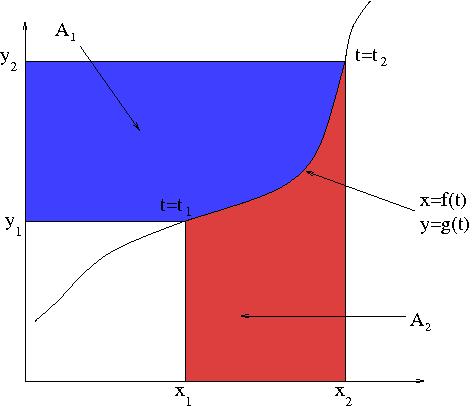
Integration By Parts: Integration by parts may be thought of as deriving the surface area of the bluish region from the total area and that of the red region. The area of the blue region is [latex]A_1=\int_{y_1}^{y_2}x(y)dy[/latex]. Similarly, the area of the carmine region is [latex]A_2=\int_{x_1}^{x_2}y(ten)dx[/latex]. The total area, [latex]A_1+A_2[/latex], is equal to the area of the bigger rectangle, [latex]x_2y_2[/latex], minus the area of the smaller i, [latex]x_1y_1[/latex]: [latex]\int_{y_1}^{y_2}x(y)dy+\int_{x_1}^{x_2}y(x)dx=\biggl.x_iy_i\biggl|_{i=1}^{i=2}[/latex]. Assuming the curve is smooth within a neighborhood, this generalizes to indefinite integrals [latex]\int xdy + \int y dx = xy[/latex], which tin be rearranged to the form of the theorem: [latex]\int xdy = xy - \int y dx[/latex].
Example
In order to calculate [latex]I=\int x\cos (ten) \,dx[/latex], let:
[latex]u = x \\ \therefore du = dx[/latex]
and
[latex]dv = \cos(x)\,dx \\ \therefore v = \int\cos(x)\,dx = \sin 10[/latex]
so:
[latex]\begin{align} \int ten\cos (x) \,dx & = \int u \, dv \\ & = uv - \int v \, du \\ & = ten\sin (x) - \int \sin (10) \,dx \\ & = x\sin (ten) + \cos (10) + C \cease{marshal}[/latex]
Trigonometric Integrals
The trigonometric integrals are a specific set of functions used to simplify complex mathematical expressions in order to evaluate them.
Learning Objectives
Solve basic trigonometric integrals
Key Takeaways
Primal Points
- Some of the expressions for the trigonometric integrals are found using properties of trigonometric functions.
- Some of the expressions were derived using techniques similar integration by parts.
- There is no guarantee that a trigonometric integral has an analytic expression.
Key Terms
- trigonometric: relating to the functions used in trigonometry: [latex]\sin[/latex], [latex]\cos[/latex], [latex]\tan[/latex], [latex]\csc[/latex], [latex]\cot[/latex], [latex]\sec[/latex]
- integral: besides sometimes called antiderivative; the limit of the sums computed in a process in which the domain of a role is divided into small-scale subsets and a possibly nominal value of the office on each subset is multiplied by the measure of that subset, all these products then being summed
Trigonometric Integrals
The trigonometric integrals are a family unit of integrals which involve trigonometric functions ([latex]\sin[/latex], [latex]\cos[/latex], [latex]\tan[/latex], [latex]\csc[/latex], [latex]\cot[/latex], [latex]\sec[/latex]). The following is a listing of integrals of trigonometric functions. Some of them were computed using properties of the trigonometric functions, while others used techniques such as integration by parts.
Generally, if the function, [latex]\sin(ten)[/latex], is any trigonometric function, and [latex]\cos(ten)[/latex] is its derivative, so
[latex]\displaystyle{\int a\cos nx\;\mathrm{d}ten = \frac{a}{n}\sin nx+C}[/latex]
In all formulas, the constant [latex]a[/latex] is assumed to be nonzero, while [latex]C[/latex] denotes the integration constant.
Integrands Involving Only Sine:
[latex]\displaystyle{\int\sin ax\;\mathrm{d}x = -\frac{1}{a}\cos ax+C\,\! \\ \int\sin^2 {ax}\;\mathrm{d}ten = \frac{ten}{ii} - \frac{1}{4a} \sin 2ax +C= \frac{x}{2} - \frac{ane}{2a} \sin ax\cos ax +C\! \\ \int\sin^three {ax}\;\mathrm{d}ten = \frac{\cos 3ax}{12a} - \frac{3 \cos ax}{4a} +C\! \\ \int 10\sin^2 {ax}\;\mathrm{d}x = \frac{x^2}{4} - \frac{ten}{4a} \sin 2ax - \frac{1}{8a^ii} \cos 2ax +C\! \\ \int x^two\sin^2 {ax}\;\mathrm{d}x = \frac{x^3}{half-dozen} - \left( \frac {x^2}{4a} - \frac{1}{8a^3} \right) \sin 2ax - \frac{ten}{4a^2} \cos 2ax +C\!}[/latex]
Integrands Involving Only Cosine:
[latex]\int\cos ax\;\mathrm{d}x = \frac{1}{a}\sin ax+C[/latex]
[latex]\int\cos^two {ax}\;\mathrm{d}x = \frac{ten}{two} + \frac{ane}{4a} \sin 2ax +C = \frac{x}{two} + \frac{1}{2a} \sin ax\cos ax +C[/latex]
[latex]\int\cos^due north ax\;\mathrm{d}ten = \frac{\cos^{northward-1} ax\sin ax}{na} + \frac{n-1}{north}\int\cos^{n-2} ax\;\mathrm{d}x \qquad\mbox{(for }northward>0\mbox{)}[/latex]
[latex]\int x\cos ax\;\mathrm{d}10 = \frac{\cos ax}{a^two} + \frac{x\sin ax}{a}+C[/latex]
[latex]\int ten^2\cos^2 {ax}\;\mathrm{d}ten = \frac{10^three}{6} + \left( \frac {ten^2}{4a} - \frac{ane}{8a^3} \right) \sin 2ax + \frac{x}{4a^2} \cos 2ax +C[/latex]
Integrands Involving Only Tangent:
[latex]\brainstorm{align}\int\tan ax\;\mathrm{d}x &= -\frac{ane}{a}\ln \left|\cos ax \right|+C\\ & = \frac{1}{a}\ln \left|\sec ax \correct|+C\terminate{marshal}[/latex]
[latex]\displaystyle{\int\tan^n ax\;\mathrm{d}x = \frac{ane}{a(north-1)}\tan^{north-1} ax-\int\tan^{due north-2} ax\;\mathrm{d}x}[/latex]
where [latex]northward \neq i[/latex]; and
[latex]\displaystyle{\int\frac{\mathrm{d}ten}{q \tan ax + p} = \frac{1}{p^2 + q^2}(px + \frac{q}{a}\ln \left|q\sin ax + p\cos ax \right|)+C }[/latex]
where [latex]p^2 + q^2 \neq 0[/latex].
Integrands Involving Only Secant:
[latex]\displaystyle{\int \sec{ax} \, \mathrm{d}x = \frac{1}{a}\ln{\left| \sec{ax} + \tan{ax}\right|}+C}[/latex]
[latex]\displaystyle{\int \sec^ii{10} \, \mathrm{d}x = \tan{x}+C}[/latex]
Integrands involving just cosecant:
[latex]\displaystyle{\int \csc{ax} \, \mathrm{d}x = \frac{i}{a}\ln{\left| \csc{ax}-\cot{ax}\right|}+C}[/latex]
[latex]\displaystyle{\int \csc^2{ten} \, \mathrm{d}x = -\cot{x}+C}[/latex]
Complicated Trigonometric Integrals
Nosotros now look at integrals involving the product of a ability of [latex]\sin x[/latex] and a power of [latex]\cos x[/latex]. Ii simple examples of such integrals are [latex]\int \sin^thou x \cos x \; \mathrm d x[/latex] and [latex]\int \cos^thousand ten \sin ten\; \mathrm d x[/latex], which tin can be solved used the substitutions [latex]u = \sin x[/latex] and [latex]u = \cos ten[/latex], respectively. We now consider the more general case of [latex]\int \sin^n 10 \cos^chiliad 10\; \mathrm d ten[/latex], where [latex]n[/latex] and [latex]yard[/latex] are positive integers.
- If [latex]n[/latex] is odd, we tin pull out one factor of [latex]\sin x[/latex], convert the balance to cosines using the identity [latex]\sin^2 x + \cos^two x = one[/latex], and then use the substitution [latex]u = \cos x[/latex].
- If [latex]1000[/latex] is odd, nosotros can pull out one factor of [latex]\cos x[/latex], catechumen the rest to sines using the identity [latex]\sin^2 x + \cos^two x = 1[/latex], and and then use the commutation [latex]u = \sin x[/latex].
- If both [latex]n[/latex] and [latex]g[/latex] are odd, we can use either of the above 2 methods.
- If both [latex]n[/latex] and [latex]m[/latex] are even, then we can attempt to utilize a combination of the following three identities: [latex]\cos^2 x = \frac{ane}{2} (1 + \cos 2x)[/latex], [latex]\sin^2 x = \frac{1}{ii} (one - \sin 2x)[/latex], and [latex]\sin ten \cos x = \frac{i}{2} \sin 2x[/latex].
Trigonometric Substitution
Trigonometric functions can exist substituted for other expressions to change the form of integrands and simplify the integration.
Learning Objectives
Use trigonometric substitution to solve an integral
Key Takeaways
Key Points
- If the integrand contains [latex]a^2 − x^2[/latex], let [latex]10 = a \sin(\theta)[/latex].
- If the integrand contains [latex]a^2 + x^2[/latex], permit [latex]10 = a \tan(\theta)[/latex].
- If the integrand contains [latex]x^two - a^2[/latex], let [latex]x = a \sec(\theta)[/latex].
Fundamental Terms
- trigonometric: relating to the functions used in trigonometry: [latex]\sin[/latex], [latex]\cos[/latex], [latex]\tan[/latex], [latex]\csc[/latex], [latex]\cot[/latex], [latex]\sec[/latex]
Trigonometric functions tin be substituted for other expressions to change the class of integrands. One may use the trigonometric identities to simplify sure integrals containing radical expressions (or expressions containing [latex]north[/latex]thursday roots). The following are general methods of trigonometric commutation, depending on the form of the part to be integrated.
Substitution Rule #1
If the integral contains [latex]a^2-x^2[/latex], let [latex]x = a \sin(\theta)[/latex] and utilize the identity:
[latex]1-\sin^2(\theta) = \cos^2(\theta)[/latex]
Commutation Rule #two
If the integrand contains [latex]a^ii+10^2[/latex], let [latex]x = a \tan(\theta)[/latex] and apply the identity:
[latex]1+\tan^2(\theta) = \sec^two(\theta)[/latex]
Substitution Rule #3
If the integrand contains [latex]x^2-a^2[/latex], permit [latex]10 = a \sec(\theta)[/latex] and apply the identity:
[latex]\sec^2(\theta)-1 = \tan^2(\theta)[/latex]
Note that, for a definite integral, one must effigy out how the bounds of integration alter due to the commutation.
Examples
In order to amend understand these substitutions, permit's go over the derivation of some of them.
Instance ane: Integrals where the integrand contains [latex]a^2 − x^2[/latex] (where [latex]a[/latex] is positive)
In the integral
[latex]\displaystyle{\int\frac{dx}{\sqrt{a^2-x^2}}}[/latex]
we may utilize:
[latex]\displaystyle{x=a\sin(\theta)\\ dx=a\cos(\theta)\,d\theta\\ \theta=\arcsin\left(\frac{x}{a}\right)}[/latex]
With the substitution, we get:
[latex]\begin{align} \int\frac{dx}{\sqrt{a^2-ten^2}} & = \int\frac{a\cos(\theta)\,d\theta}{\sqrt{a^ii-a^two\sin^2(\theta)}} \\ &= \int\frac{a\cos(\theta)\,d\theta}{\sqrt{a^2(1-\sin^2(\theta))}} \\ &= \int\frac{a\cos(\theta)\,d\theta}{\sqrt{a^two\cos^2(\theta)}} \\ &= \int d\theta \\ &= \theta+C \\ &= \displaystyle{\arcsin \left(\frac{x}{a}\correct)}+C \end{align}[/latex]
Example 2: Integrals where the integrand contains [latex]a^2 − x^two[/latex] (where [latex]a[/latex] is not zero)
In the integral
[latex]\displaystyle{\int\frac{dx}{{a^2+10^ii}}}[/latex]
we may employ:
[latex]\displaystyle{x=a\tan(\theta)\\ dx=a\sec^2(\theta)\,d\theta\\ \theta=\arctan\left(\frac{x}{a}\correct)}[/latex]
With the substitution, we become:
[latex]\begin{align}\int\frac{dx}{{a^2+x^2}} &= \int\frac{a\sec^2(\theta)\,d\theta}{{a^ii+a^two\tan^2(\theta)}} \\ &= \int\frac{a\sec^2(\theta)\,d\theta}{{a^ii(1+\tan^2(\theta))}} \\ &= \int \frac{a\sec^2(\theta)\,d\theta}{{a^2\sec^2(\theta)}} \\ &= \int \frac{d\theta}{a} \\ &= \frac{\theta}{a}+C \\ &= \frac{1}{a} \arctan \left(\frac{x}{a}\right)+C\end{align}[/latex]
The Method of Partial Fractions
Fractional fraction expansions provide an approach to integrating a general rational function.
Learning Objectives
Use partial fraction decomposition to integrate rational functions
Key Takeaways
Key Points
- Any rational role of a real variable tin be written equally the sum of a polynomial and a finite number of rational fractions whose denominator is the power of an irreducible polynomial and whose numerator has a degree lower than the degree of this irreducible polynomial.
- The substitution [latex]u = ax + b[/latex], [latex]du = a \,dx[/latex] reduces the integral every bit the following: [latex]\int {i \over ax+b}\,dx = {1 \over a} \ln\left|ax+b\correct|+C[/latex].
- When in that location is an irreducible 2nd-degree polynomial in the denominator, complete the square and modify the variable.
Key Terms
- irreducible: unable to exist factorized into polynomials of lower caste, equally [latex]x^2 + 1[/latex]
Partial fraction expansions provide an arroyo to integrating a full general rational function. Any rational role of a real variable can be written as the sum of a polynomial and a finite number of rational fractions whose denominator is the power of an irreducible polynomial and whose numerator has a caste lower than the degree of this irreducible polynomial. Hither are some common examples.
A 1st-Degree Polynomial in the Denominator
The substitution [latex]u = ax + b[/latex], [latex]du = a \,dx[/latex] reduces the integral [latex]\int {i \over ax+b}\,dx[/latex] to:
[latex]\begin{marshal}\int {i \over u}\,{du \over a}&={1 \over a}\int{du\over u}\\ &={one \over a}\ln\left|u\correct|+C \\ &= {one \over a} \ln\left|ax+b\right|+C\end{align}[/latex]
A Repeated 1st-Caste Polynomial in the Denominator
The aforementioned substitution reduces such integrals as [latex]\int {one \over (ax+b)^eight}\,dx[/latex] to
[latex]\begin{align}\int {ane \over u^8}\,{du \over a}&={i \over a}\int u^{-8}\,du \\ &= {1 \over a} \cdot{u^{-vii} \over(-7)}+C \\ &= {-1 \over 7au^7}+C \\ &= {-i \over 7a(ax+b)^7}+C\end{align}[/latex]
An Irreducible second-Degree Polynomial in the Denominator
Next nosotros consider integrals such as
[latex]\displaystyle{\int {x+vi \over x^ii-8x+25}\,dx}[/latex]
The quickest way to see that the denominator, [latex]10^two − 8x + 25[/latex], is irreducible is to observe that its discriminant is negative. Alternatively, we tin complete the foursquare:
[latex]\brainstorm{marshal}x^ii-8x+25&=(x^2-8x+16)+9\\ &=(ten-iv)^2+9\terminate{align}[/latex]
and observe that this sum of two squares can never be [latex]0[/latex] while [latex]x[/latex] is a existent number. In society to make use of the substitution
[latex]\begin{align} u & = x^2-8x+25 \\ du & =(2x-eight)\,dx \\ \frac{du}{ii} & = (x-4)\,dx \end{align}[/latex]
we would demand to find [latex](x-4)[/latex] in the numerator. So nosotros decompose the numerator [latex]10 + 6[/latex] as [latex](x-4) + x[/latex], and we write the integral as
[latex]\displaystyle{\int {x-4 \over x^2-8x+25}\,dx + \int {10 \over 10^two-8x+25}\,dx}[/latex]
The commutation handles the outset summand, thus:
[latex]\begin{align}\int \frac{10-4}{ten^ii-8x+25}\,dx &= \int \frac{\displaystyle{\frac{du}{2}}}{u} \\ &= \frac{1}{2}\ln\left|u\right|+C \\ &= \frac{1}{ii}\ln(x^2-8x+25)+C\end{align}[/latex]
Note that the reason we tin can discard the absolute value sign is that, as we observed earlier, [latex](x-4)^two + nine[/latex] can never be negative.
Next we must treat the integral
[latex]\displaystyle{\int {10 \over 10^2-8x+25} \, dx}[/latex]
With a little more than algebra,
[latex]\brainstorm{align} \int {10 \over x^2-8x+25} \, dx &= \int {ten \over (x-four)^ii+9} \, dx \\ & = \int \frac{\displaystyle{\frac{10}{9}}}{\left(\displaystyle{\frac{x-4}{3}}\right)^two+i}\,dx \\ &= {10 \over 3} \arctan\left(\frac{10-four}{3}\correct) + C \end{marshal}[/latex]
Putting information technology all together:
[latex]\displaystyle{\int {ten + six \over x^2-8x+25}\,dx = {1 \over ii}\ln(x^two-8x+25) + {x \over iii} \arctan\left({x-iv \over 3}\correct) + C}[/latex]
Integration Using Tables and Computers
Tables of known integrals or computer programs are commonly used for integration.
Learning Objectives
Recognize which integrals should exist solved using tables or computers due to their complexity
Key Takeaways
Cardinal Points
- While differentiation has easy rules by which the derivative of a complicated function tin can be plant by differentiating its simpler component functions, integration does not.
- In books with integral tables, a compilation of a list of integrals and techniques of integral calculus can be found.
- At that place are several commercial softwares, such as Mathematica or Matlab, that tin perform symbolic integration.
Key Terms
- integral: also sometimes called antiderivative; the limit of the sums computed in a procedure in which the domain of a function is divided into pocket-size subsets and a possibly nominal value of the function on each subset is multiplied past the measure of that subset, all these products then being summed
Integration is the basic functioning in integral calculus. While differentiation has piece of cake rules by which the derivative of a complicated function can be found by differentiating its simpler component functions, integration does not, then tables of known integrals are oft useful. We as well may take to resort to computers to perform an integral.
Integration Using Tables
A compilation of a list of integrals and techniques of integral calculus was published past the German mathematician Meyer Hirsch equally early on as in 1810. More than extensive tables were compiled in 1858 past the Dutch mathematician David de Bierens de Haan. A new edition was published in 1862. These tables, which incorporate mainly integrals of unproblematic functions, remained in use until the middle of the 20th century. They were then replaced by the much more extensive tables of Gradshteyn and Ryzhik. Here are a few examples of integrals in these tables for logarithmic functions:
[latex]\int\ln ax\;dx = x\ln ax - ten[/latex]
[latex]\displaystyle{\int\ln (ax + b)\;dx = \frac{(ax+b)\ln(ax+b) - ax}{a}}[/latex]
[latex]\int (\ln 10)^ii\; dx = 10(\ln x)^ii - 2x\ln x + 2x[/latex]
[latex]\displaystyle{\int (\ln x)^n\; dx = ten\sum^{n}_{k=0}(-1)^{north-k} \frac{n!}{k! }(\ln ten)^g}[/latex]
[latex]\displaystyle{\int \frac{dx}{\ln x} = \ln\left|\ln ten \right| + \ln 10 + \sum^\infty_{yard=ii}\frac{(\ln x)^k}{k\cdot k! }}[/latex]
[latex]\displaystyle{\int \frac{dx}{(\ln ten)^n} = -\frac{x}{(due north-1)(\ln x)^{n-1}} + \frac{1}{northward-1}\int\frac{dx}{(\ln x)^{north-one}} \qquad\mbox{(for }n\neq 1\mbox{)}}[/latex]
You can certainly encounter that these integrals are difficult to exercise merely "past mitt."
Integration Using Computers
Computers may be used for integration in 2 principal ways. First, numerical methods using computers tin be helpful in evaluating a definite integral. In that location are many methods and algorithms. We will briefly larn most numerical integration in some other cantlet. Second, in that location are several commercial softwares, such as Mathematica or Matlab, that can perform symbolic integration.
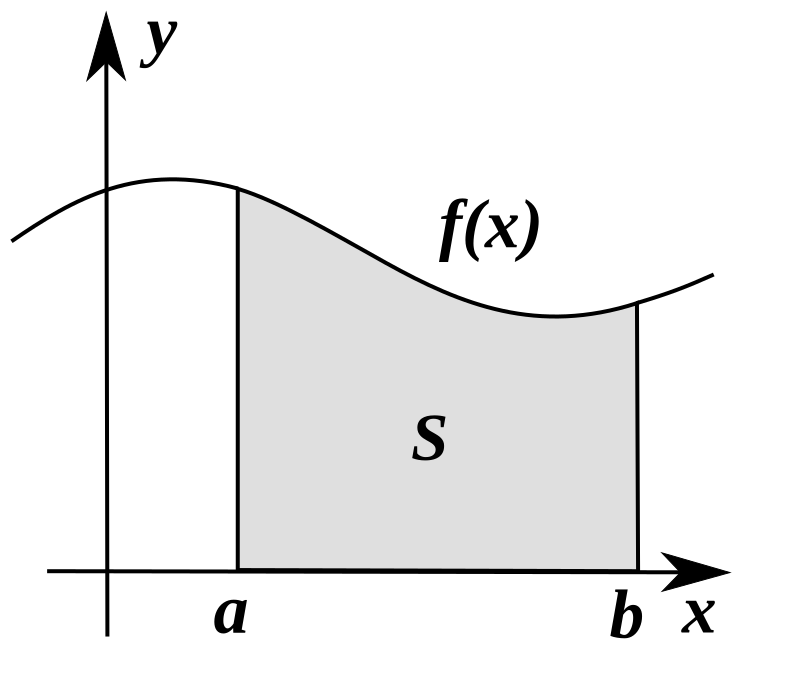
Integration: Numerical integration consists of finding numerical approximations for the value [latex]Southward[/latex].
Example: Mathematica's symbolic integration produces the following result:
[latex]\int \log(1-10^2) dx = -2x-\log(ten-1) + \log(1+x) +x \log(one-x^2).[/latex]
These programs know how to perform nearly any integral that can be done analytically or in terms of standard mathematical functions.
Approximate Integration
The trapezoidal rule (likewise known as the trapezoid rule or trapezium dominion) is a technique for approximating the definite integral [latex]\int_{a}^{b} f(x)\, dx[/latex].
Learning Objectives
Use the trapezoidal rule to estimate the value of a definite integral
Central Takeaways
Cardinal Points
- The trapezoidal rule works by approximating the region under the graph of the role [latex]f(x)[/latex] equally a trapezoid and calculating its area: [latex]\int_{a}^{b} f(x)\, dx \approx (b-a)\frac{f(a) + f(b)}{2}[/latex].
- For a domain discretized into [latex]N[/latex] equally spaced panels, or [latex]North+1[/latex] grid points [latex](1, 2, \cdots, North+i)[/latex], where the grid spacing is [latex]h=\frac{(b-a)}{North}[/latex], the approximation to the integral becomes [latex]\int_{a}^{b} f(x)\, dx = \frac{b-a}{2N}(f(x_1) + 2f(x_2) + 2f(x_3) + \ldots + 2f(x_N) + f(x_{Due north+1}))[/latex].
- In two and more than dimensions, where unproblematic approximation methods become prohibitively expensive in terms of computational effort, one may use other methods such equally the Monte Carlo method.
Key Terms
- trapezoid: a (convex) quadrilateral with two (non-adjacent) parallel sides
Numerical integration, in some instances besides known equally numerical quadrature, asks for the value of a definite integral. Popular methods employ ane of the Newton–Cotes formulas (such as midpoint rule or Simpson'south rule) or Gaussian quadrature. These methods rely on a "divide and conquer" strategy, whereby an integral on a relatively large fix is broken down into integrals on smaller sets. In college dimensions, where these methods go prohibitively expensive in terms of computational effort, one may apply other methods such as the Monte Carlo method. Hither, we volition study a very simple approximation technique, called a trapezoidal rule.
Trapezoidal rule
The trapezoidal rule (as well known equally the trapezoid rule or trapezium rule) is a technique for approximating the definite integral [latex]\int_{a}^{b} f(x)\,dx[/latex]. The trapezoidal rule works by approximating the region under the graph of the office [latex]f(x)[/latex] as a trapezoid and calculating its expanse. It follows that:
[latex]\displaystyle{\int_{a}^{b} f(x)\, dx \approx (b-a)\frac{f(a) + f(b)}{two}}[/latex]
The trapezoidal dominion tends to get extremely accurate when periodic functions are integrated over their periods.
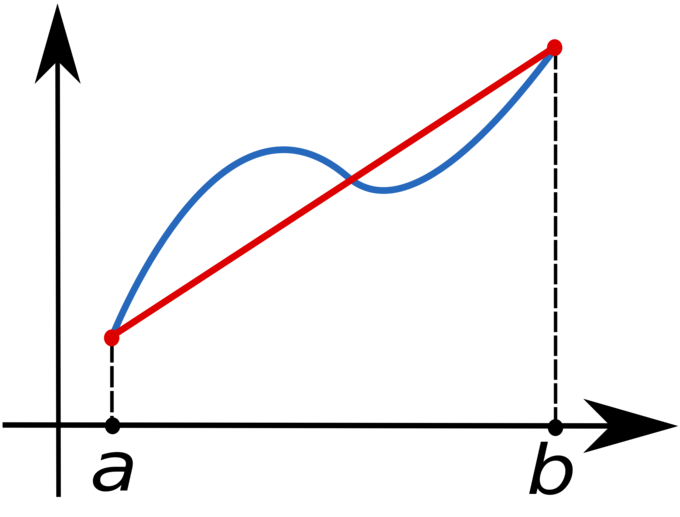
Approximation by Linear Functions: The function [latex]f(x)[/latex] (in blue) is approximated by a linear part (in cherry-red).
Numerical Implementation of the Trapezoidal Rule
For a domain discretized into [latex]Due north[/latex] equally spaced panels, or [latex]N+ane[/latex] filigree points [latex](i, 2, \cdots, Northward+ane)[/latex], where the grid spacing is [latex]h=\frac{(b-a)}{Northward}[/latex], the approximation to the integral becomes:
[latex]\begin{align}\int_{a}^{b} f(x)\, dx &\approx \frac{h}{2} \sum_{chiliad=ane}^{N} \left( f(x_{grand+1}) + f(x_{yard}) \right) {} \\ &= \frac{b-a}{2N}(f(x_1) + 2f(x_2) + \cdots + 2f(x_N) + f(x_{N+1}))\end{align}[/latex]
Although the method can prefer a nonuniform grid besides, this example used a compatible grid for the the approximation.
Improper Integrals
An Improper integral is the limit of a definite integral as an endpoint of the integral interval approaches either a real number or [latex]\infty[/latex] or [latex]-\infty[/latex].
Learning Objectives
Evaluate improper integrals with infinite limits of integration and infinite aperture
Primal Takeaways
Cardinal Points
- An improper integral may exist a limit of the form [latex]\lim_{b\to\infty} \int_a^bf(x)\, \mathrm{d}x, \, \lim_{a\to -\infty} \int_a^bf(10)\, \mathrm{d}x[/latex].
- Information technology could as well exist a limit of the grade [latex]\lim_{c\to b^-} \int_a^cf(x)\, \mathrm{d}y,\, \lim_{c\to a^+} \int_c^bf(x)\, \mathrm{d}x[/latex], in which one takes a limit in 1 or the other (or sometimes both) endpoints.
- It is often necessary to use improper integrals in order to compute a value for integrals which may not exist in the conventional sense (equally a Riemann integral, for instance) because of a singularity in the function, or an infinite endpoint of the domain of integration.
Key Terms
- integrand: the function that is to be integrated
- definite integral: the integral of a function betwixt an upper and lower limit
An improper integral is the limit of a definite integral as an endpoint of the interval(s) of integration approaches either a specified real number or [latex]\infty[/latex] or [latex]-\infty[/latex] or, in some cases, as both endpoints arroyo limits. Such an integral is often written symbolically only similar a standard definite integral, perchance with infinity as a limit of integration. Merely that conceals the limiting process.
Specifically, an improper integral is a limit of 1 of two forms.
Starting time, an improper integral could be a limit of the course:
[latex]\displaystyle \lim_{b\to\infty} \int_a^bf(x)\, \mathrm{d}ten, \, \lim_{a\to -\infty} \int_a^bf(x)\, \mathrm{d}x[/latex]
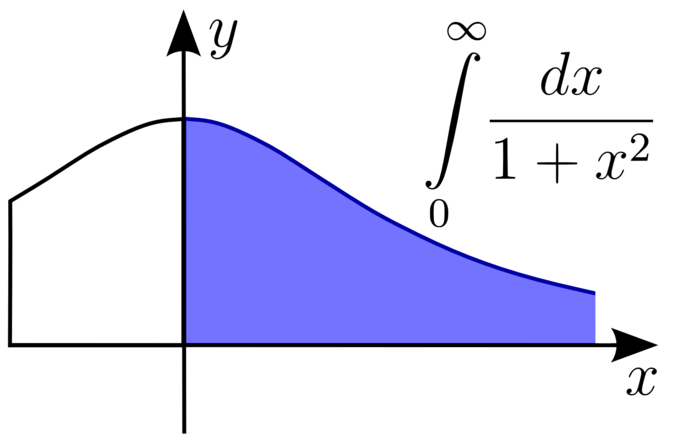
Improper Integral of the Kickoff Kind: The integral may need to be divers on an unbounded domain.
Second, an improper integral could be a limit of the form:
[latex]\displaystyle \lim_{c\to b^-} \int_a^cf(10)\, \mathrm{d}y,\, \lim_{c\to a^+} \int_c^bf(ten)\, \mathrm{d}x[/latex]
in which i takes a limit at ane endpoint or the other (or sometimes both).
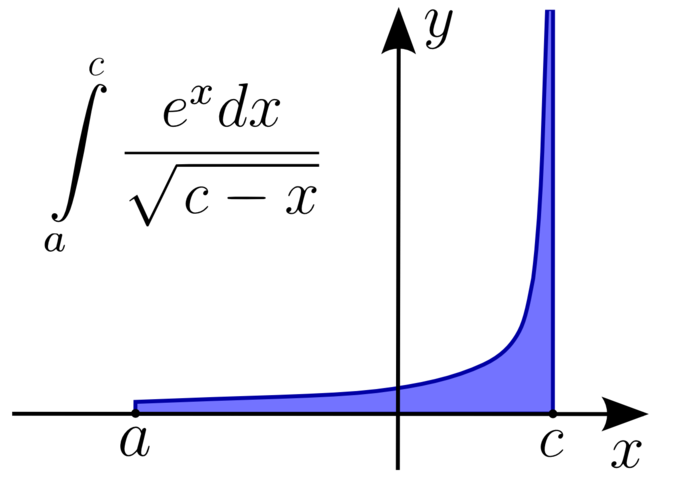
Improper Integral of the 2nd Kind: An improper Riemann integral of the second kind.The integral may fail to be because of a vertical asymptote in the role.
Integrals are besides improper if the integrand is undefined at an interior point of the domain of integration, or at multiple such points. Information technology is oftentimes necessary to apply improper integrals in gild to compute a value for integrals which may not exist in the conventional sense (equally a Riemann integral, for instance) because of a singularity in the office, or an infinite endpoint of the domain of integration.
Instance 1
The original definition of the Riemann integral does not apply to a function such as [latex]\frac{i}{10^2}[/latex] on the interval [latex][1, \infty][/latex], considering in this case the domain of integration is unbounded. Even so, the Riemann integral can frequently exist extended by continuity, by defining the improper integral instead every bit a limit:
[latex]\begin{align} \int_1^\infty \frac{1}{x^two}\,\mathrm{d}x &=\lim_{b\to\infty} \int_1^b\frac{1}{x^2}\,\mathrm{d}x \\ &= \lim_{b\to\infty} \left(-\frac{ane}{b} + \frac{1}{1}\right) \\ &= 1\end{marshal}[/latex]
Example ii
The narrow definition of the Riemann integral also does not cover the function [latex]\frac{1}{\sqrt{x}}[/latex] on the interval [latex][0, 1][/latex]. The problem hither is that the integrand is unbounded in the domain of integration (the definition requires that both the domain of integration and the integrand be divisional). All the same, the improper integral does exist if understood equally the limit
[latex]\begin{align}\displaystyle \int_0^1 \frac{one}{\sqrt{x}}\,\mathrm{d}x &=\lim_{a\to 0^+}\int_a^1\frac{i}{\sqrt{x}}\, \mathrm{d}x \\ &= \lim_{a\to 0^+}(2\sqrt{1}-2\sqrt{a})\\ &=ii\end{align}[/latex]
Numerical Integration
Numerical integration constitutes a broad family unit of algorithms for calculating the numerical value of a definite integral.
Learning Objectives
Solve definite integrals
Key Takeaways
Central Points
- The bones problem considered by numerical integration is to compute an estimate solution to a definite integral: [latex]\int_a^b\! f(ten)\, dx[/latex].
- There are several reasons for carrying out numerical integration. It could exist due to the specific nature of the role (to be integrated) or its antiderivatives.
- A big class of quadrature rules can be derived by constructing interpolating functions which are easy to integrate. Typically these interpolating functions are polynomials. Midpoint method and trapezoidal method are simple examples.
Cardinal Terms
- trapezoidal: in the shape of a trapezoid, or having some faces which have one pair of parallel sides
- antiderivative: an indefinite integral
Numerical integration constitutes a wide family unit of algorithms for calculating the numerical value of a definite integral, and, by extension, the term is also sometimes used to depict the numerical solution of differential equations. This article focuses on calculation of definite integrals. The term numerical quadrature (ofttimes abbreviated to quadrature) is more or less a synonym for numerical integration, especially as practical to one-dimensional integrals. Numerical integration over more than than one dimension is sometimes described as cubature, although the meaning of quadrature is understood for higher dimensional integration as well.
The basic problem considered by numerical integration is to compute an estimate solution to a definite integral:
[latex]\displaystyle{\int_a^b\! f(x)\, dx}[/latex]
If [latex]f(10)[/latex] is a smooth well-behaved role, integrated over a small number of dimensions and the limits of integration are bounded, at that place are many methods of approximating the integral with capricious precision.
Reasons for numerical integration
- At that place are several reasons for carrying out numerical integration. The integrand [latex]f(10)[/latex] may be known but at certain points, such every bit when obtained past sampling. Some embedded systems and other estimator applications may demand numerical integration for this reason.
- A formula for the integrand may exist known, but information technology may be hard or incommunicable to find an antiderivative which is an simple function. An example of such an integrand [latex]f(ten)=\exp(-x^2)[/latex], the antiderivative of which (the error function, times a abiding) cannot be written in elementary form.
- It may be possible to find an antiderivative symbolically, but it may be easier to compute a numerical approximation than to compute the antiderivative. That may exist the case if the antiderivative is given as an space series or product, or if its evaluation requires a special role which is non bachelor.
Methods for One-Dimensional Integrals
A large grade of quadrature rules tin can exist derived by constructing interpolating functions which are easy to integrate. Typically these interpolating functions are polynomials. The simplest method of this blazon is to let the interpolating function exist a constant part (a polynomial of degree cypher) which passes through the point [latex]\left(\frac{(a+b)}{two}, f\left(\frac{(a+b)}{2}\right)\right)[/latex]. This is called the midpoint rule or rectangle dominion:
[latex]\displaystyle{\int_a^b f(x)\,dx \approx (b-a) \, f\left(\frac{a+b}{2}\right)}[/latex]
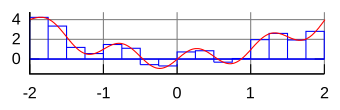
Rectangle Rule: Illustration of the rectangle rule.
The interpolating role may exist an affine function (a polynomial of degree 1) which passes through the points [latex](a, f(a))[/latex] and [latex](b, f(b))[/latex]. This is called the trapezoidal rule.
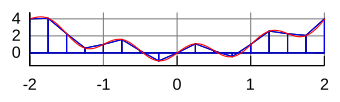
Trapezoidal Rule: Illustration of the trapezoidal dominion.
For either i of these rules, we can brand a more than accurate approximation by breaking upwards the interval [latex][a, b][/latex] into some number [latex]n[/latex] of subintervals, computing an approximation for each subinterval, then adding upward all the results. This is called a composite dominion, extended rule, or iterated rule. For example, the composite trapezoidal rule can be stated equally
[latex]\displaystyle{\int_a^b f(ten)\,dx \approx \frac{b-a}{north} \left( {f(a) \over 2} + \sum_{k=1}^{n-1} \left( f \left( a+k \frac{b-a}{n} \right) \right) + {f(b) \over 2} \right)}[/latex]
where the subintervals have the form [latex][k h, (grand+1) h][/latex], with [latex]h= \frac{(b-a)}{n}[/latex] and [latex]g = 0, 1, 2, \cdots, n−1[/latex].
andersonconalothe1964.blogspot.com
Source: https://courses.lumenlearning.com/boundless-calculus/chapter/techniques-of-integration/
0 Response to "Do You Need to Know Techniques of Integration"
Post a Comment